
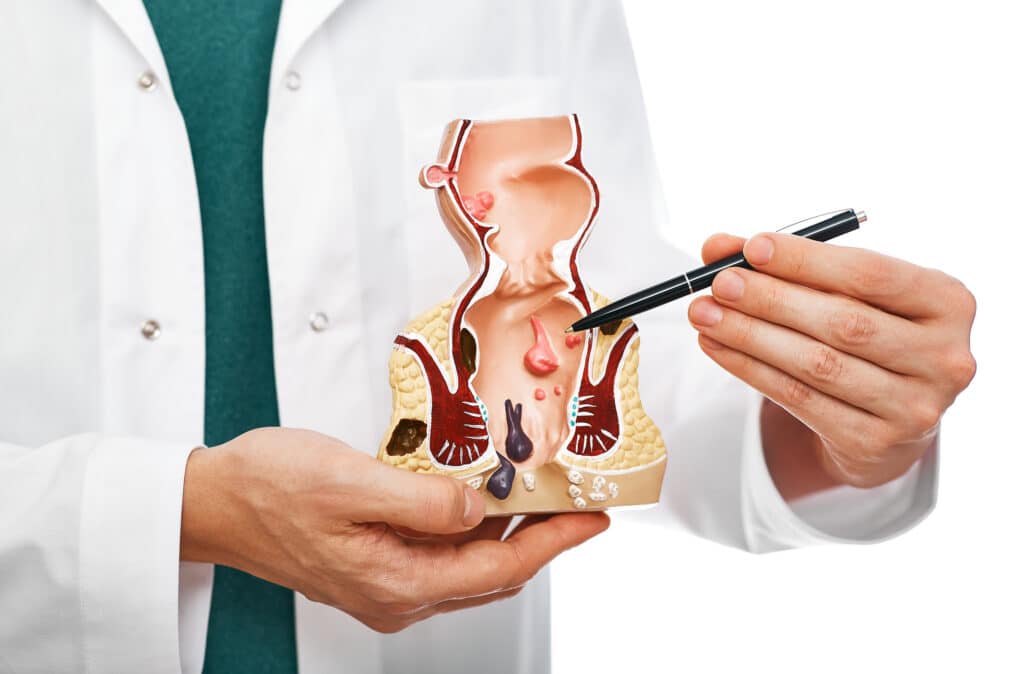
Hemorrhoid artery embolization (HAE) and hemorrhoidectomy treat troublesome hemorrhoids in very different ways. A hemorrhoidectomy surgically removes hemorrhoidal tissue, while HAE uses a catheter to reduce blood flow to symptomatic internal hemorrhoids. That distinction can affect factors like discomfort, downtime, and anesthesia.
Serving St. Louis, Florissant, Kirkwood, and Mehlville, MO, as well as Swansea, IL, Midwest Institute for Non-Surgical Therapy specializes in minimally invasive, image-guided care. Medical Director Dr. Goke Akinwande is a board-certified interventional radiologist trained at the University of Pittsburgh Medical Center and Johns Hopkins Hospital. He also previously served on the faculty at Washington University and Barnes-Jewish Hospital.
How Does Hemorrhoid Artery Embolization Work?
HAE treats internal hemorrhoids from inside your blood vessels rather than through the rectum. A small catheter is inserted through an artery, usually at the wrist or groin, and imaging helps guide it toward arteries supplying the hemorrhoidal tissue. Small particles are then released to reduce blood flow.
As the blood supply decreases, the enlarged tissue can gradually shrink. Bleeding may improve first, while pressure, swelling, and other symptoms can lessen over the following weeks.
HAE generally involves local anesthesia at the catheter entry site, sometimes with light sedation. It’s performed on an outpatient basis, so you typically return home the same day.
How Is a Hemorrhoidectomy Different?
A hemorrhoidectomy is a surgical procedure that physically removes hemorrhoidal tissue. It’s a well-established treatment and may be recommended for more advanced hemorrhoids, particularly large external hemorrhoids or combined internal and external hemorrhoids.
Because tissue is surgically removed, recovery is usually more involved. Pain after bowel movements, wound care, and temporary changes to normal activities can be part of the healing period.
HAE doesn’t involve rectal incisions or tissue removal. For someone with symptomatic internal hemorrhoids who wants to avoid surgery, that can make embolization worth discussing.
Which Hemorrhoid Treatment Is Right for You?
Neither treatment is automatically better for every case. The choice depends heavily on the location and severity of your hemorrhoids and the symptoms bothering you most.
HAE may be considered when internal hemorrhoids cause persistent bleeding, swelling, pressure, or other symptoms that haven’t improved enough with conservative care. Some people with prolapsing internal hemorrhoids might also be candidates, depending on the severity of their condition. Hemorrhoidectomy may make more sense when significant external disease is present or surgical removal is medically preferable.
HAE is also a newer technique than traditional hemorrhoidectomy. Research has shown encouraging symptom relief with relatively low postprocedural discomfort, but long-term and head-to-head evidence is still developing. A medical evaluation can clarify which type of hemorrhoid you have before a treatment is selected.
Explore a Minimally Invasive Option for Hemorrhoids
Persistent hemorrhoid symptoms don’t always mean surgery is your only procedural choice. To discuss your condition and treatment options, contact MINT at (866) 938-6573. The team performs HAE for appropriate cases across the St. Louis area, including Florissant, Kirkwood, Mehlville, MO, and Swansea, IL.